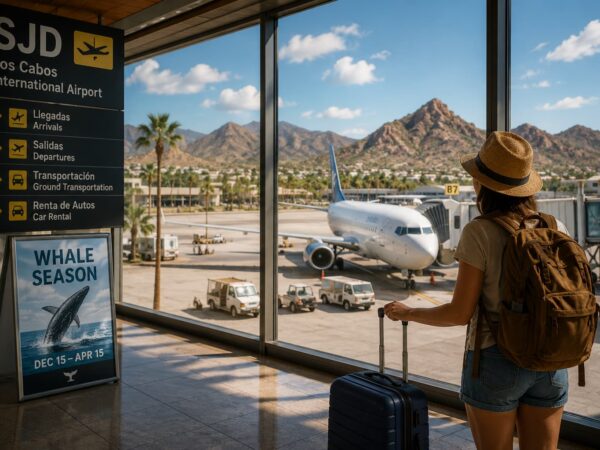
Cabo San Lucas sits at the tip of the Baja California Peninsula, at the exact point where the Pacific Ocean meets the Sea of Cortez. Every winter, between roughly December 15 and April 15, thousands of humpback and gray whales arrive in those waters to breed, give birth, and nurse their calves. For anyone who has looked at a world map and thought about what aviation makes accessible that wasn’t accessible a century ago, this is a precise example: a destination so geographically remote that it remained practically inaccessible until the modern airport and jet service changed the equation entirely.
Los Cabos International Airport (SJD) is about 45 kilometers from Cabo San Lucas town. It receives direct flights from most major US and Canadian cities — Los Angeles, Seattle, Dallas, Chicago, Denver, Toronto — with flight times ranging from 2.5 hours from the West Coast to around 4.5 hours from the Midwest and East. Without that infrastructure, the whale watching experience that now draws tens of thousands of visitors per season would require either a several-day overland journey down the Baja Peninsula or a multi-day Pacific sea voyage. The jet bridge changed what’s possible.
This piece covers the aviation-related decisions that meaningfully affect your Cabo whale watching experience — arrival timing relative to the season, morning departure dynamics, flight-to-tour coordination, and why the specific week you choose to fly matters more here than at most beach destinations.
The Whale Season Window and What It Means for Booking Flights
Unlike most wildlife tourism that runs year-round with peak and off-peak variations, Cabo whale watching has a hard calendar. December 15 to April 15. Outside that window, the whales are simply not there. Humpbacks migrate from their summer feeding grounds in Alaska and the North Pacific, traveling thousands of miles to these warm shallow waters to breed and give birth, then return north as water temperatures rise.
The implications for flight planning are specific:
Flying before December 15 — you will encounter dolphin watching and scenic sailing past The Arch, but no whale sighting guarantee applies and the biologist-led whale tours are not running. December 1 to 14 is shoulder time: Cabo is warm and accessible but whale season has not yet officially opened.
January through March is the core of the season and the peak of airline traffic to SJD. This is when humpback mothers are nursing newborn calves, when males are displaying and breaching to attract mates, and when the whale activity visible from the water is at its highest frequency. It is also when seats on flights to SJD book up earliest and when hotel rates hit their seasonal peak. The aviation-and-tourism relationship here is direct: airline capacity to SJD increases noticeably in January and February relative to October and November, reflecting how well the industry has learned to track whale tourism demand.
April 1 to 15 is the closing window. Humpbacks begin moving north. Sightings continue but the density of activity is lower than February. Airlines start reducing capacity back to shoulder-season levels. For travelers who have flexibility, early April can be an interesting combination: meaningful whale sighting chances, thinner tourist crowds, and sometimes meaningfully lower airfares than peak January/February.
Flying out on the last day of your trip deserves specific logistical thought. Whale watching tours typically depart at 8 AM and return around 11 AM. SJD handles significant international departure traffic from late morning through afternoon. If you are doing a whale tour on your last day, you need a departure no earlier than 2 PM to comfortably complete the tour, transfer to the airport, and clear international departure procedures. This is worth building into your flight selection before you finalize the itinerary, not after.
SJD: The Airport, the Route, and Why It Matters
Los Cabos International Airport opened in 1960 and has expanded significantly since, handling roughly 8 to 10 million passengers annually by the mid-2020s. It is the second busiest airport in Mexico for international arrivals after Cancún’s, which itself reflects how dramatically Baja California Sur transformed as a tourist destination in the jet age.
The airport has two terminals. Terminal 1 handles domestic Mexico flights (Aeromexico, Volaris, VivaAerobus). Terminal 2 handles most US and Canadian carriers — American, United, Delta, Southwest, WestJet, Air Canada, Alaska Airlines, and several charter operators during peak season. International arrivals involve Mexican immigration and customs processing, which at peak whale season can run 45 minutes to 90 minutes from wheels-down to exiting the terminal.
The 45-kilometer road transfer to Cabo San Lucas town takes approximately 45 minutes to 1 hour depending on traffic, which in January and February can be slow through the San José del Cabo corridor. Airport ground transportation options:
Shared shuttle — the most common choice for independent travelers, typically $20 to $30 per person, with stops at multiple hotels. Budget 75 to 90 minutes door to door.
Private transfer — approximately $60 to $90 for the vehicle (not per person), direct to your accommodation, 50 to 60 minutes. Worth it if you are arriving late or managing a group.
Taxi — metered at the airport, typically $80 to $100 for the full ride to Cabo San Lucas. Higher than private transfer options; only advisable if the transfer services are sold out at peak periods.
Car rental — available at SJD, worth considering if you plan to explore independently beyond Cabo San Lucas. The Baja California Sur highway system is well-maintained and the drive is straightforward.
What this transfer time means practically: if you arrive on a flight landing at 6 PM, you will reach your Cabo San Lucas hotel no earlier than 7:30 to 8 PM. Most whale watching tour operators require confirmation of your tour by 5 PM the day before your departure, and the best biologist-led tours require advance booking well ahead of arrival. Arriving and immediately trying to book a morning tour for the next day is possible but risky during peak season — the most popular departures are sold out.
Morning Departure Timing and Why Your Flight Arrival Day Matters
The best Cabo whale watching tours depart between 7:30 and 8:30 AM. This is not incidental. Mornings in the Sea of Cortez offer calmer sea conditions, better light for photography, and whale activity patterns that are more predictable and higher-frequency than afternoon windows. Marine biologists on these tours have consistently documented that the early morning period coincides with heightened surface behavior — breaching, pectoral slapping, spy-hopping — that makes for the most spectacular viewing and the best sighting probability.
The practical aviation implication: your arrival day is not your whale watching day. Plan to arrive at Cabo at least one day before you want to be on the water. A traveler who lands at SJD at noon on December 26 can, in theory, book a December 27 morning tour. But they have arrived with no whale watching time remaining on December 26, and if their December 27 tour conflicts with any airport-related delay (late baggage, slow immigration, transfer issues), they lose that morning. Arriving two days before your first planned whale tour gives you a comfortable buffer, and it gives you the first full day in Cabo to orient, visit the marina area, confirm your booking, and simply enjoy the town.
For families with children — who are among the most enthusiastic whale watching participants and for whom the experience tends to be genuinely formative — the jet lag factor is worth acknowledging. Even a 2.5-hour time difference from the US West Coast affects small children’s morning alertness. Building an arrival day buffer means your children are rested and genuinely present for a 7:30 AM boat departure rather than groggy and resistant.
Which Flights Actually Work: Route and Timing Analysis
From the US West Coast (Los Angeles, San Francisco, Seattle, Las Vegas):
Flight times to SJD run 2.5 to 3 hours. This is the most operationally flexible route. A 7 AM departure from LAX lands at SJD by 9:30 AM local time, allowing a full afternoon in Cabo on arrival day. Alaska Airlines, Southwest, United, and American all run direct routes. During January and February, LA-SJD fares typically run $200 to $450 round trip; booking 6 to 8 weeks ahead is when prices are most favorable.
From the US Southwest (Phoenix, Denver):
Nonstop flights from PHX run approximately 2 hours. From DEN, roughly 3.5 hours. These routes fill fast in January because the Phoenix-to-Cabo traveler is the demographic most aligned with Baja winter escapes. Southwest runs high-frequency PHX-SJD during peak season. Southwest’s flexible change policy is particularly relevant here given that whale weather windows can shift — a storm front that cancels one morning’s tours is worth rebooking around if you can.
From the US Midwest and East Coast (Chicago, Dallas, Houston, New York):
Most travelers connect through a West Coast hub — LAX, PHX, SAN, or LAS — adding roughly 2 to 3 hours to total travel time. American’s Dallas-SJD nonstop is one of the few direct options from the central US and typically runs once or twice daily. United offers Houston-SJD nonstop seasonally. From New York (JFK or EWR), the most efficient routing is usually JFK-LAX-SJD, though American’s JFK-DFW-SJD connection works well if the Dallas segment has a two-hour or longer connection.
From Canada:
WestJet and Air Canada run direct Vancouver-SJD and Calgary-SJD routes that become particularly frequent during whale season, reflecting the strength of Canadian whale tourism demand. Toronto travelers typically connect through a Canadian gateway or through a US hub. The Canada-to-Cabo routing increased significantly in the 2020s as direct service expanded, shortening travel times that previously required same-day connections.
Arriving at night versus the following morning:
A common mistake aviation-savvy travelers avoid: booking a red-eye that arrives in Cabo after midnight and then planning a 7:30 AM whale watching tour the same morning. Six hours of sleep after a long travel day, in a new hotel, ahead of an early marine departure, is not a good setup for what can be a physically active morning. Unless you are specifically comfortable with overnight flight rhythms, arriving the previous evening — even late — and sleeping properly before a morning whale tour produces a meaningfully better experience.
The Cabo San Lucas Marina: What Arriving Travelers Need to Know
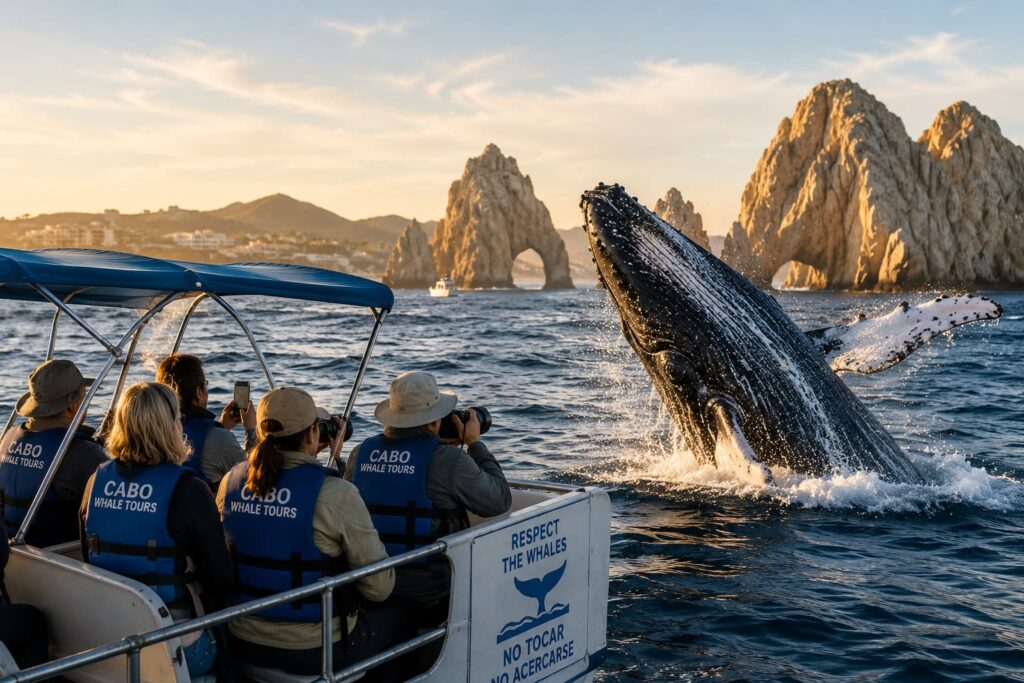
Whale watching tours depart from the Cabo San Lucas marina and, for some operators, from the nearby IGY Marina. The marina is approximately 5 to 10 minutes by taxi from most Cabo San Lucas hotels. If you are staying in the Medano Beach resort corridor, it is sometimes walkable.
The marina area is worth visiting on the afternoon of your arrival day regardless of logistics. You can see the boats, confirm your departure dock, identify the meeting point your tour operator specified, and get a visual sense of the sea conditions for the following morning. Tour operators generally require guests to arrive at the marina 15 minutes before departure. Given the early morning timing (7:30 to 8 AM), knowing exactly where to go the night before eliminates a stressful variable.
The most-booked tour on Cabo Whale Tours — the Small Group Whale Watching Tour with Biologist and Free Professional Photos — has over 9,000 departures and carries a 5.0 guest rating. It operates on a 12-person maximum with a marine biologist guide and a hydrophone that lets passengers hear humpback songs live underwater. It runs December 15 through April 15 and books out weeks ahead during January and February. If this is the tour you want, booking before you book your flights is not an irrational sequence.
For the biologist-led zodiac tour, which operates with a maximum of 10 guests on a more maneuverable vessel, the same advice applies — smaller boats offer closer proximity to whales, but the smaller group cap means they fill fastest. The 100% whale sighting guarantee on both tours is backed by years of local knowledge about where the humpbacks concentrate.
Practical Aviation Notes for Cabo Whale Watching Travelers
SJD security and US Pre-Clearance: Unlike cancun, SJD does not have US CBP pre-clearance. Returning US travelers clear US customs on arrival at their first US port. Factor this into connections — if you are connecting through LAX or PHX on the return, you will need time for US immigration even on a domestic-appearing connecting flight.
Checked luggage and whale watching: Most whale watching tours run 2 to 3 hours on the water, and you need very little — sunscreen, a light jacket, camera, water. Heavy gear is not required and most tours provide life jackets and safety equipment. If you are traveling with diving gear or snorkeling equipment, check the airline’s equipment policies in advance; wetsuits and fins are the items most often flagged for additional baggage fees.
Weather and the aviation backup plan: Cabo has one of the most reliably clear winter climates anywhere in Mexico — roughly 300 days of sunshine annually. Tour cancellations due to weather are uncommon but not impossible, particularly early in the season (December to early January) when Pacific storm systems occasionally push into Baja. Most reputable operators offer free rescheduling if weather forces a cancellation. If you have a single whale watching day in your itinerary and weather cancels it, knowing your departure flight timing and whether you have any flexibility is worth having worked out in advance. A Friday or Saturday departure gives more rescheduling options than a rigid midweek flight.
Flight confirmation the night before a whale tour: This is a simple habit worth establishing. Confirm your return flights the evening before any early whale watching departure. An unexpected flight change or cancellation requiring you to be at the airport by 8 AM on a day you planned to be on the water for whales is the kind of conflict that ruins both activities. Check-in the night before and confirm your itinerary so the morning belongs to the whales, not your phone.
The full-day whale shark tour to La Paz and flight planning: For travelers interested in the whale shark snorkeling experience from Cabo to La Paz — an approximately 10-hour day with a 6 AM departure and 5 to 6 PM return — this must be scheduled on a day with no travel obligations. A 3-hour highway drive each way, with federal permit requirements in the whale shark swimming zone, makes this incompatible with any same-day flight commitment. Schedule it as a mid-trip day with at least one full day of buffer before any departure.
Why Cabo Whale Season Justifies the Flight
The aviation industry’s contribution to wildlife tourism is something worth appreciating directly: the ability to be in Los Angeles at dinner and watching a humpback whale breach in the Sea of Cortez at 9 the following morning is a logistical achievement that would have been inconceivable to naturalists a century ago. John James Audubon spent months traveling to reach species he wanted to study. The gray whale’s migration from Alaska to Baja, a journey of 12,000 miles that is one of the longest known mammal migrations on Earth, once made the whales essentially inaccessible for observation except to people who could invest weeks or months of travel. Now a domestic flight and a morning boat ride puts a non-specialist face to face with the same animals.
The Cabo Whale Tours platform provides the interface between that flight and the experience — verified local operators, marine biologist guides, hydrophone access, and a 100% sighting guarantee across a tour roster that ranges from the $81 sunrise catamaran to private 45-foot yacht charters. The Sea of Cortez, which the late Jacques Cousteau called “the aquarium of the world,” remains one of the most accessible genuine wildlife encounters that modern aviation puts within reach of a weekend.
For anyone who finds themselves reading an aviation blog and also wondering what to do in Mexico in January, the answer is specific: book the flights, book the whale tour before the flights ideally, arrive one day ahead, take the morning departure, and bring a long lens.
[For more aviation news, travel planning, and insights on where flying takes us, explore the posts on this site.]
About the author: Written by a travel and aviation writer with particular interest in how modern air travel has transformed access to the natural world and wildlife tourism destinations.